In this post, we’ll be solving LeetCode problem 1143.
We have two strings text1 and text2 with sizes \(n\) and \(m\), respectively.
We want to find the length of their longest common subsequence (LCS).
A subsequence of a string s is obtained by deleting zero or more characters from s.
Strategy
Let’s assume we have two strings: s1 with size n1 and s2 with size n2.
Let’s also assume we know their LCS length.
What can we say about LCS length when we append a character c1 to s1 and a character c2 to s2?
The new characters are the same
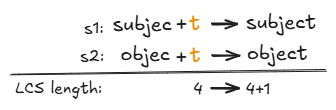
If c1 and c2 are the same, then the new LCS is the previous LCS plus the new character c1 (or c2, they are the same after all). The new LCS length is thus one plus the previous LCS length.
For example, say s1 = subjec and s2 = objec.
The LCS is bjec and has length 4.
We now add t to both, so c1 = t and c2 = t. The new strings are s1 = subject and s2 = object.
The new LCS is bject and has length 5.
The new characters are different
What if they’re not the same?
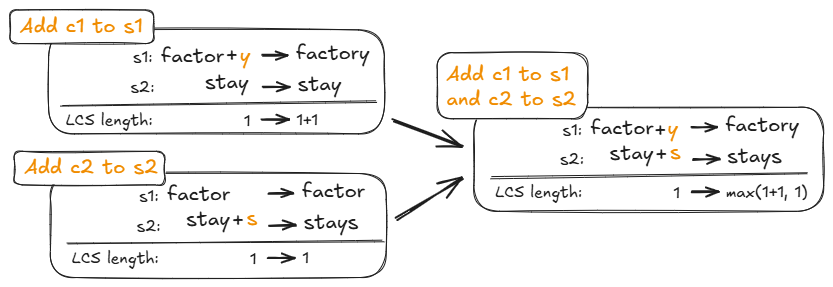
In this case, just adding c1 to s1 and keeping s2 unchanged may be enough to increase LCS length. We can add c2 to s2 afterwards, even though it won’t increase LCS length. The same goes for the reverse case: we may increase LCS length by adding c2 to s2. We can add c1 to s1 afterwards.
We’re interested in the longer of these two lengths.
The new LCS length is thus the maximum of two LCS lengths: one where we only add c1 to s1 and one where we only add c2 to s2. Let’s look at an example below, where s1 = factor and s2 = stay. We try to add c1 = y and c2 = s.
Basic implementation
We will implement our approach using recursion. We’ll write a function lcsLength(string *text1, string *text2, int i, int j). This function will return LCS length of text1 up to index i (inclusive) and text2 up to index j (inclusive). This will be like adding text1[i] to s1 and text[j] to s2. We’ll pass in pointers to strings to avoid copying entire strings in each recursive call. The basic function can be implemented as follows:
int lcsLength(string *text1, string *text2, int i, int j) {
    if (i < 0 || j < 0) {
        return 0;
    }
    if (text1->at(i) == text2->at(j)) {
        return lcsLength(text1, text2, i - 1, j - 1) + 1;
    } else {
        return max(
            lcsLength(text1, text2, i - 1, j),
            lcsLength(text1, text2, i, j - 1)
        );
    }
}
Implementation with dynamic programming
The issue with the above code is that we call lcsLength multiple times with the same values of i and j. This wastes a lot of computation time, and causes a combinatorial explosion of the number of computations across recursive calls. We fix this by creating a matrix lcsLengthCache of size n x m which holds the computed values. Whenever we call lcsLength, we first check if the result is already in our matrix and attempt to return that instead of recomputing everything. We initialize the matrix with -1 in all cells, which indicates that the value had not yet been computed. Reusing computations in such a way is called dynamic programming.
vector<vector<int>> lcsLengthCache;  // must be initialized to size n x m

int lcsLength(string *text1, string *text2, int i, int j) {
    if (i < 0 || j < 0) {
        return 0;
    }
    if (lcsLengthCache[i][j] == -1) {
        if (text1->at(i) == text2->at(j)) {
            lcsLengthCache[i][j] = lcsLength(text1, text2, i - 1, j - 1) + 1;
        } else {
            lcsLengthCache[i][j] = max(
                lcsLength(text1, text2, i - 1, j),
                lcsLength(text1, text2, i, j - 1)
            );
        }
    }
    return lcsLengthCache[i][j];
}
Full solution
Since the sizes of text1 and text2 are n and m, we want to compute lcsLength(&text1, &text2, n - 1, m - 1). This will be the LCS length across the entirety of both strings. Below is the full code.
class Solution {
public:
    vector<vector<int>> lcsLengthCache;
    int lcsLength(string *text1, string *text2, int i, int j) {
        if (i < 0 || j < 0) {
            return 0;
        }
        if (lcsLengthCache[i][j] == -1) {
            if (text1->at(i) == text2->at(j)) {
                lcsLengthCache[i][j] = lcsLength(text1, text2, i - 1, j - 1) + 1;
            } else {
                lcsLengthCache[i][j] = max(
                    lcsLength(text1, text2, i - 1, j),
                    lcsLength(text1, text2, i, j - 1)
                );
            }
        }
        return lcsLengthCache[i][j];
    }

    int longestCommonSubsequence(string text1, string text2) {
        int n = text1.size();
        int m = text2.size();
        lcsLengthCache = vector<vector<int>>(n, vector<int>(m, -1));
        return lcsLength(&text1, &text2, n - 1, m - 1);
    }
};
Time complexity analysis
The code passes all tests with a runtime of 55ms and 27.66 MB memory usage. There are a bunch of avenues for optimization, but the solution clearly highlights the approach and benefits of dynamic programming.
The total space complexity is \(O(nm + n + m)\) to hold the matrix and both inputs. It can be simplified to \(O(nm)\).
The total time complexity is \(O(nm)\) as we need at most \(nm\) evaluations of lcsLength to compute the final output by filling the entire matrix.
Thanks for reading! If you liked this post, you can support me on Ko-fi ☕. More LeetCode solutions coming soon :)